The close bond between St.Sergius and St.Bacchus has been emphasized since the earliest accounts, and recent scholarship has proposed their homosexuality. The oldest record of their martyrdom describes them as erastai (Greek for “lovers”). Scholars believe that they may have been united in the rite of adelphopoiesis (brother-making), a kind of early Byzantine Christian same-sex marriage. Worship of these coupled Saints was very popular amongst the Roman army.
The Roman Catholic Church stripped St.Sergius and St.Bacchus from its liturgical calendar in 1969 – the same year that New York’s Stonewall riots launched the modern gay liberation movement. Supposedly they were “de-canonized” due to lack of historical evidence, but some see it as an anti-gay action since they clearly had churches dedicated to them long before medieval times.St.Sergius and St.Bacchus continue to be popular saints with Christian Arabs and now among LGBT Christians and their allies.
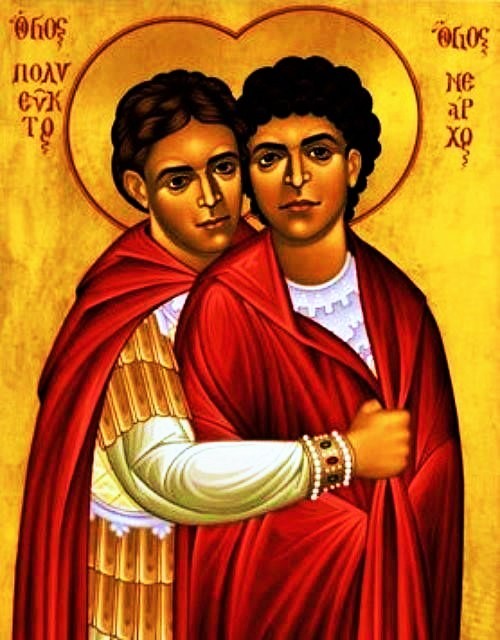
It’s not a huge deal but I’m inclined to correct the above image because hey, then we can celebrate two lovely mlm couples!! The above image is actually of Saints Polyeuct and Nearchos, not Sergius and Bacchus. Below are two depictions of Sergius and Bacchus:
I include the second image because it depicts Jesus (the little head floating between the two men) as the pronobus, or best man, who in Roman tradition oversaw the wedding of a husband and wife (cf John Boswell, Same-Sex Unions in Premodern Europe).
Anyhow, the first image as well as that of Polyeuct and Nearchos above are both icons created by Brother Robert Lentz, an American Franciscan friar. Here’s his description of Polyeuct and Nearchos:
‘ Soldiers in the Roman army and deeply attached to each other, they were both stationed in Militene, Armenia. The earliest account of Polyeuct’s martyrdom was written by Nearchus. The primary thread running through his narration is the desire of these two friends to spend eternity together. According to the text, when the emperor issues a new edict against Christians, Nearchus is terribly upset. He is worried that, since Polyeuct is a pagan and Nearchus a Christian, his own possible martyrdom and the eventual death of Polyeuct might lead to their being in separate places in the afterlife. Polyeuct reassures him that he has long been drawn to Christianity and intends to die a Christian. With a convert’s fervor, Polyeuct then attacks a pagan procession and gets himself arrested. The judge turns out to be his own father-in-law, Felix, who begs him to reconsider.
Polyeuct’s wife, Paulina, comes to court and unsuccessfully implores him, for the sake of their marriage and their son, to change his mind. After severe tortures, he is condemned to death. Just before he is beheaded, Polyeuct sees Nearchus near. His final words to Nearchus are “Remember our secret vow.” Nearchus recorded this story, which was recounted annually at the church and eventually erected over Polyeuct’s tomb in Militene. In the year 527, a great church with a gold-plated ceiling was built in Constantinople and dedicated to St. Polyeuct. Later in the same century, Gregory of Tours wrote that the most solemn oaths were usually sworn in this church; because Polyeuct had come to be considered the special heavenly protector of vows and avenger of broken promises.
The inscription on the bottom of the icon is a rendering of the saint’s names in classical Armenian, to honor the location of their story. ’
And if you want to hear his description of Sergius and Bacchus, see here.


 lavenduers